
3-Mercaptopropionic Acid as a Chain Transfer Agent: How 3-MPA Works in Polymerization
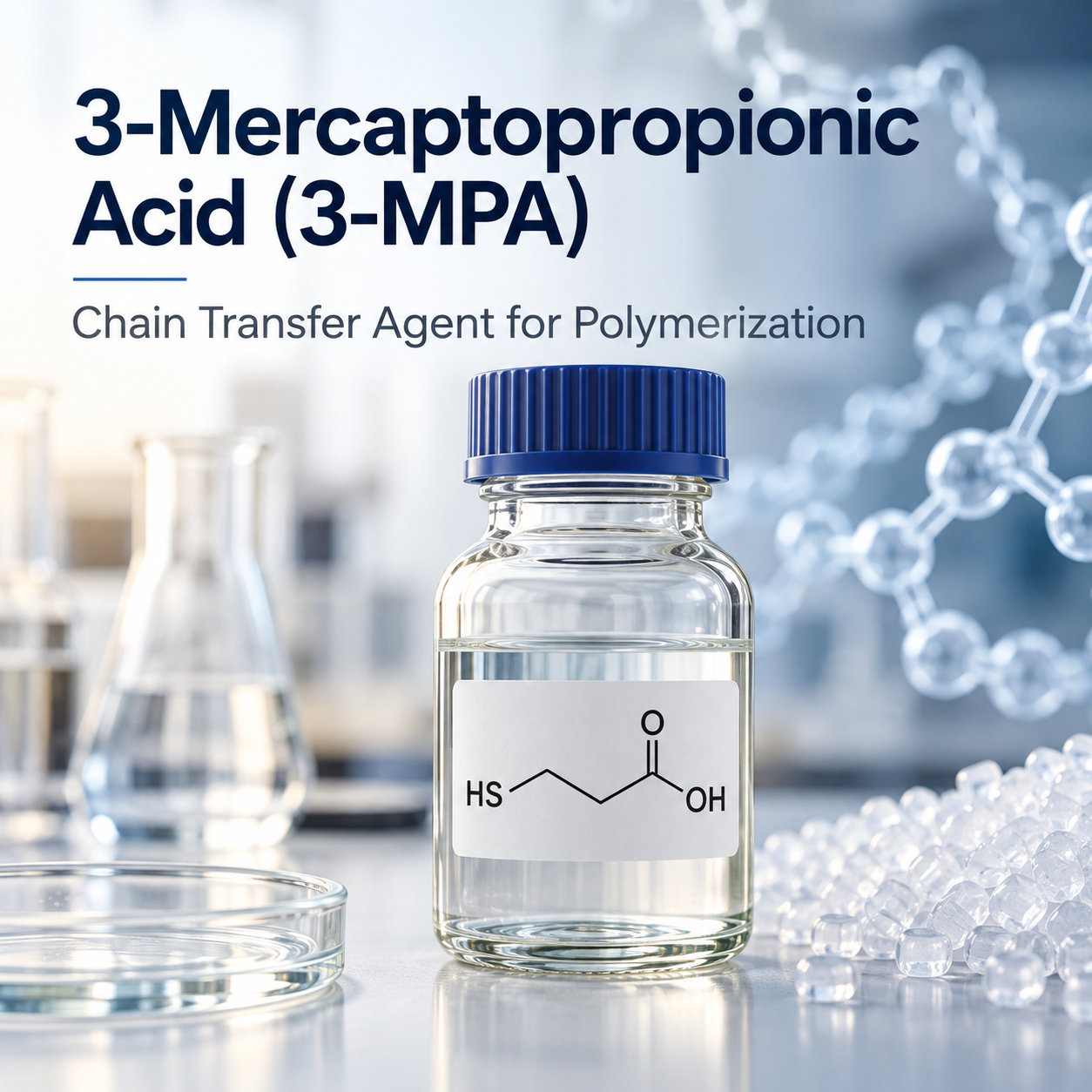
3-Mercaptopropionic Acid, commonly abbreviated as 3-MPA, is an organosulfur compound containing both a thiol group and a carboxyl group.
Its chemical structure makes it useful in a number of industrial chemical reactions.
One of its important application areas is polymerization, where 3-MPA may be used as a chain transfer agent in suitable systems.
In polymer production, molecular weight can strongly influence properties such as:
viscosity;
processability;
solution behavior;
mechanical properties;
coating performance;
downstream formulation behavior.
For this reason, controlling polymer chain growth is often an important part of formulation design.
3-MPA can participate in this process in certain free-radical polymerization systems.
1. What Is a Chain Transfer Agent?
During free-radical polymerization, active polymer chains continue growing by reacting with monomers.
If chain growth continues without sufficient control, the resulting polymer may reach a molecular weight that is different from the formulation target.
A chain transfer agent participates in the reaction by transferring the active radical from a growing polymer chain to another molecule.
This process can influence:
polymer chain length;
average molecular weight;
molecular weight distribution;
viscosity of the polymer solution or dispersion.
The final result depends on the complete polymerization system.
2. Why Can 3-MPA Act as a Chain Transfer Agent?
The thiol group in 3-MPA can participate in radical transfer reactions.
Under suitable polymerization conditions, the sulfur-hydrogen bond can be involved in chain-transfer behavior.
A simplified description is:
growing polymer radical → reaction with 3-MPA → termination or transfer of the original chain → formation of a new radical species
This can reduce the average chain length compared with a system operating under otherwise similar conditions without the chain transfer agent.
However, the actual effect depends on factors such as:
monomer type;
initiator;
reaction temperature;
solvent;
solids content;
3-MPA dosage;
polymerization time.
3. Does More 3-MPA Always Mean Lower Molecular Weight?
Not necessarily in a simple linear way.
Increasing the amount of a chain transfer agent may influence molecular weight, but the final result depends on the overall polymerization kinetics.
A formulation may respond differently depending on:
monomer composition;
reaction temperature;
initiator concentration;
addition method;
conversion level;
reactor conditions.
Therefore, 3-MPA dosage should not be treated as a universal number.
It should be determined through controlled formulation testing.
4. Why Is Molecular Weight Control Important?
Polymer molecular weight can influence many practical properties.
For example, depending on the polymer system, molecular weight may affect:
Viscosity
Higher molecular weight may increase solution or dispersion viscosity.
Processing
A polymer that is too viscous may become more difficult to pump, mix or apply.
Film Properties
Molecular weight can influence film formation and mechanical behavior.
Solubility
Some polymer systems become more difficult to dissolve as molecular weight increases.
Application Performance
Coatings, adhesives, dispersants and other polymers may require a defined molecular-weight range to meet formulation targets.
For this reason, chain transfer agents are often evaluated as part of polymerization control.
5. In Which Polymerization Systems Can 3-MPA Be Considered?
3-MPA may be evaluated in some free-radical polymerization systems involving monomers such as:
acrylic acid derivatives;
methacrylic monomers;
vinyl monomers;
other polymerizable monomer systems.
The suitability of 3-MPA depends on the specific monomers and process conditions.
It should not be assumed that one chain transfer agent performs the same way in every polymerization system.
6. 3-MPA in Acrylic Polymerization
Acrylic polymer systems are widely used in:
coatings;
adhesives;
dispersants;
textile chemicals;
construction chemicals;
water-treatment polymers;
specialty formulations.
In some acrylic polymerization processes, 3-MPA can be evaluated as a chain transfer agent to help control polymer molecular weight.
The effect can depend on:
acrylic monomer composition;
neutralization level;
reaction temperature;
initiator system;
concentration;
feed rate;
target molecular weight.
Therefore, industrial use generally requires formulation-specific testing.
7. Can 3-MPA Be Used with Acrylic Acid?
3-MPA may be used in some polymerization systems involving acrylic acid or acrylic-acid-based monomers.
However, the appropriate dosage and addition method depend on the reaction design.
Factors to consider include:
total monomer concentration;
initiator type;
polymerization temperature;
degree of neutralization;
reaction pH;
desired molecular weight.
A dosage used successfully in one acrylic polymerization process should not automatically be transferred to another formulation.
8. Can 3-MPA Be Used in Polycarboxylate-Related Polymerization?
3-MPA may be evaluated as a chain-transfer-related raw material in some polymer synthesis systems associated with polycarboxylate chemistry.
Its role would depend on the polymer design, monomer structure, initiator system and target molecular architecture.
In this type of application, the product should be tested within the actual reaction formulation rather than selected only by product name.
The final polymer performance can depend on many variables beyond the chain transfer agent.
9. How Does 3-MPA Dosage Affect Polymerization?
Changing the 3-MPA dosage may influence:
polymer chain length;
molecular weight;
viscosity;
conversion behavior;
residual monomer;
reaction rate;
final polymer properties.
The direction and magnitude of these changes depend on the polymerization system.
This is why laboratory trials are usually necessary before changing the dosage on a production scale.
10. Why Should Dosage Be Tested in Gradients?
Using only one dosage level may not provide enough information.
A more practical approach is to establish several test levels.
For example:
Control formulation → low dosage → medium dosage → higher dosage
Then compare:
molecular weight;
viscosity;
conversion;
color;
residual monomer;
application performance.
This allows the formulation team to identify a suitable operating range.
11. How Should 3-MPA Be Added During Polymerization?
The addition method can influence the reaction.
Depending on the process, 3-MPA may be:
added at the beginning;
added continuously;
fed together with monomers;
introduced separately during polymerization.
Different addition methods can affect local concentration and reaction behavior.
Therefore, industrial users should select the addition method according to their reactor design and polymerization process.
12. Does Reaction Temperature Affect the Function of 3-MPA?
Yes.
Temperature influences free-radical generation, reaction rate and chain-transfer behavior.
At different temperatures, the same formulation may produce different:
conversion rates;
molecular weights;
viscosities;
reaction times.
For this reason, dosage comparisons should be conducted under controlled temperature conditions.
13. Does the Initiator System Matter?
Yes.
The initiator determines how radicals are generated in the polymerization system.
Different initiator systems can change:
radical concentration;
reaction rate;
molecular weight;
interaction with chain transfer agents.
Therefore, 3-MPA should be evaluated together with the actual initiator used in production.
14. 3-MPA vs Other Mercapto Chain Transfer Agents
Several mercapto compounds can be used as chain transfer agents.
They differ in:
molecular structure;
functional groups;
molecular weight;
solubility;
reactivity;
odor;
compatibility with the reaction system.
Therefore, 3-MPA should not automatically be considered interchangeable with another mercapto compound on a one-to-one basis.
Any substitution should be supported by comparative polymerization testing.
15. Why Is the Carboxyl Group in 3-MPA Important?
3-MPA contains both:
a thiol group;
a carboxyl group.
The thiol group is associated with chain-transfer behavior.
The carboxyl group can influence:
polarity;
solubility;
compatibility;
downstream polymer functionality.
This dual-functional structure is one reason 3-MPA is considered in specific polymer synthesis applications.
16. What Specifications Matter When Purchasing 3-MPA?
When purchasing 3-Mercaptopropionic Acid for industrial use, buyers may consider:
assay;
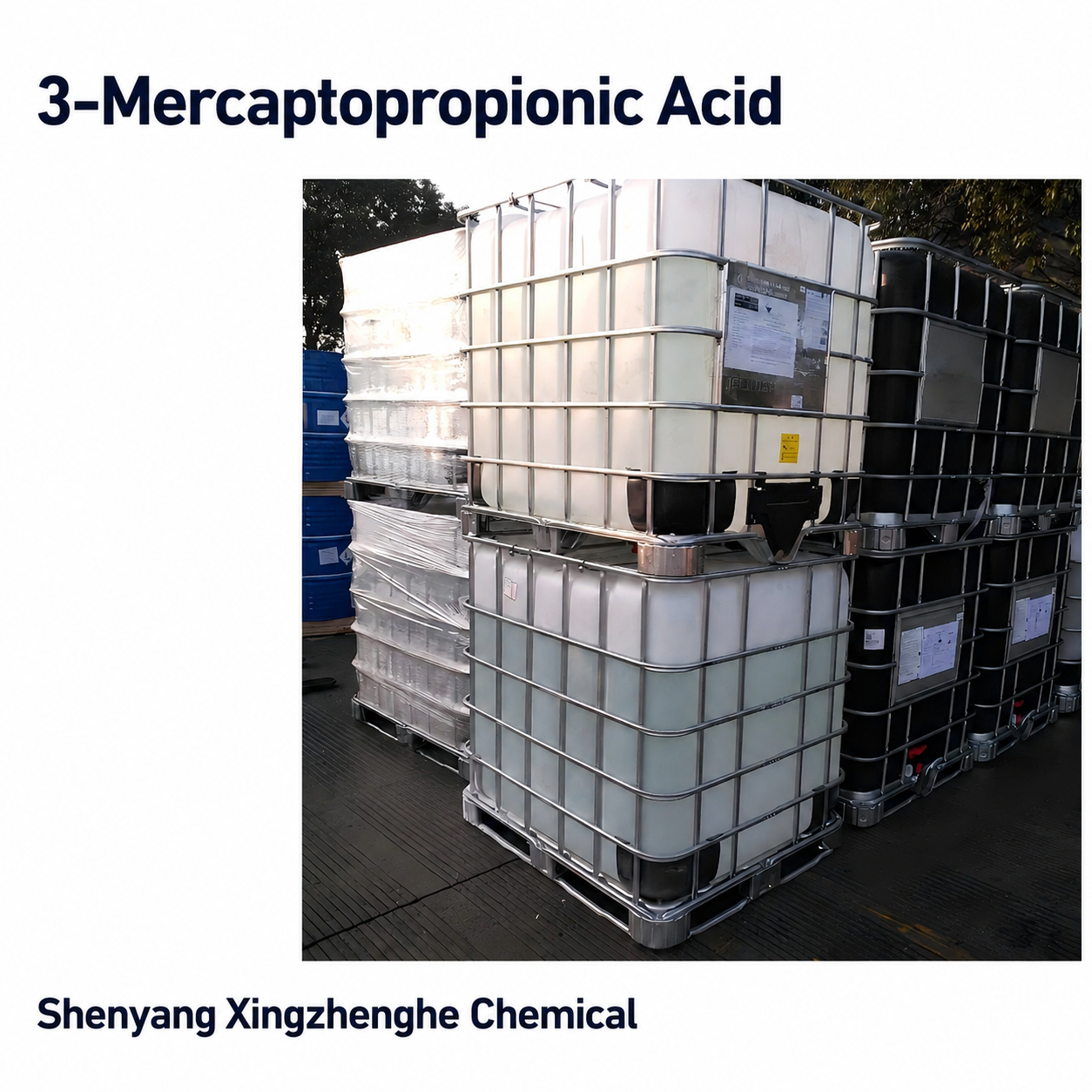
appearance;
water content;
color;
related impurities;
packaging;
storage conditions.
The importance of each specification depends on the downstream process.
For polymerization applications, batch-to-batch consistency may also be relevant.
17. Why Is Assay Important?
Assay indicates the proportion of the target chemical in the product.
For a reactive raw material, assay can influence the actual amount of functional material introduced into the reactor.
However, assay alone does not fully determine performance.
Other factors may include:
moisture;
impurities;
storage condition;
process compatibility.
Therefore, industrial buyers should review both product specifications and actual application results.
18. Why Does Water Content Matter?
Water content may be important in polymerization systems where reaction concentration or solvent balance needs to be controlled.
A change in water content can influence:
actual formulation concentration;
reaction conditions;
effective raw-material dosage.
Whether water content is critical depends on the specific process.
19. Why Does Color Matter?
Color can be an important specification for some downstream products.
For example, polymer systems used in coatings, resins or specialty chemicals may have appearance requirements.
However, color alone should not be used as the only quality indicator.
It should be evaluated together with chemical specifications and process performance.
20. Why Is Batch Consistency Important?
Polymerization processes can be sensitive to raw-material variation.
If a chain transfer agent changes significantly between batches, the polymerization result may also change.
Therefore, users involved in continuous production may consider:
batch assay;
moisture;
color;
impurity profile;
production performance.
Consistency should be evaluated according to the buyer's own production requirements.
21. Why Is Sample Testing Recommended?
3-MPA is often used as a reactive raw material.
Its suitability cannot always be determined from a technical data sheet alone.
A sample trial allows the customer to evaluate the product under actual process conditions.
During testing, it is useful to keep the following variables consistent:
monomer composition;
initiator;
temperature;
reaction time;
equipment;
solids content.
Then only the 3-MPA source or dosage is changed.
This creates a more meaningful comparison.
22. What Should Be Measured During a 3-MPA Trial?
Depending on the polymer system, useful parameters may include:
molecular weight;
molecular weight distribution;
viscosity;
monomer conversion;
residual monomer;
product color;
solids content;
downstream application performance.
The relevant test items should be selected according to the target polymer.
23. Can 3-MPA Directly Replace Another Chain Transfer Agent?
Not necessarily.
Even if two chemicals are both classified as chain transfer agents, they may have different chain-transfer efficiencies and compatibility.
A direct replacement may change:
molecular weight;
viscosity;
conversion;
polymer structure;
application properties.
Therefore, substitution should be evaluated through controlled comparative testing.
24. What Information Should Be Provided When Requesting a 3-MPA Quote?
To obtain a more suitable quotation and product recommendation, buyers can provide:
Required Product
3-Mercaptopropionic Acid.
CAS Number
107-96-0.
Required Specification
For example, assay or other technical requirements.
Application
Polymerization, organic synthesis or another industrial use.
Required Quantity
Sample, trial quantity or commercial order.
Packaging Requirement
If specific packaging is required.
Destination
Country, city or port.
This information helps confirm product specification, packaging and transportation conditions.
25. How Should 3-MPA Be Stored?
3-MPA should be stored according to the supplier's technical and safety documentation.
Important points may include:
keeping the package closed;
preventing contamination;
controlling storage temperature;
separating incompatible substances;
following workplace ventilation requirements.
The applicable safety data sheet should be consulted before handling and storage.
26. What Documents May Be Requested for 3-MPA?
Depending on the order and market requirements, buyers may request:
product specification;
certificate of analysis;
technical data sheet;
safety data sheet;
packaging information;
transportation-related documentation.
Specific documentation should be confirmed according to the product and destination country.
27. How to Evaluate a 3-Mercaptopropionic Acid Supplier
When evaluating a supplier, industrial buyers may consider:
whether the required specification can be supplied;
whether batch documentation is available;
whether samples can be provided;
whether packaging meets transportation requirements;
whether export documentation can be prepared;
whether supply conditions match the purchasing plan.
For polymerization raw materials, application compatibility is also an important consideration.
Frequently Asked Questions
What is 3-Mercaptopropionic Acid?
3-Mercaptopropionic Acid is an organosulfur compound containing both thiol and carboxyl functional groups. It can be used as a chemical raw material or intermediate in different industrial reactions.
What is the CAS number of 3-MPA?
The commonly referenced CAS number is 107-96-0.
Is 3-MPA a chain transfer agent?
3-MPA can be used as a chain transfer agent in suitable free-radical polymerization systems.
How does 3-MPA control molecular weight?
Its thiol group can participate in radical chain-transfer reactions, which can influence polymer chain length and molecular weight.
What is the recommended dosage of 3-MPA?
There is no universal dosage. The appropriate amount depends on monomer type, initiator, temperature, target molecular weight and process conditions.
Can 3-MPA be used in acrylic polymerization?
It may be used in some acrylic polymerization systems, but the actual formulation should be tested under the intended process conditions.
Can 3-MPA replace another mercapto chain transfer agent?
Not automatically. Different mercapto compounds can have different reactivity and compatibility, so comparative testing is recommended.
What specifications should be checked when buying 3-MPA?
Depending on the application, buyers may consider assay, water content, color, impurities, packaging and batch consistency.
3-Mercaptopropionic Acid Supply and Sample Inquiry
For customers evaluating 3-Mercaptopropionic Acid for polymerization or chemical synthesis, it is useful to provide:
required specification + application + trial or order quantity + packaging requirement + destination
Based on the actual purchasing requirement, product specifications, sample availability, packaging and relevant technical documents can then be confirmed.
For first-time use or supplier replacement, a controlled sample trial can help determine whether the material is suitable for the existing production process.
 3-Mercaptopropionic Acid in Th
 How to Review a 3-MPA COA: Ass
 3-MPA vs Other Mercapto Chain
 How to Select a Reliable 3-Mer