
3-Mercaptopropionic Acid (3-MPA): Applications in Polymer Modification, Coatings and Chemical Synthesis
What Is 3-Mercaptopropionic Acid (3-MPA)?
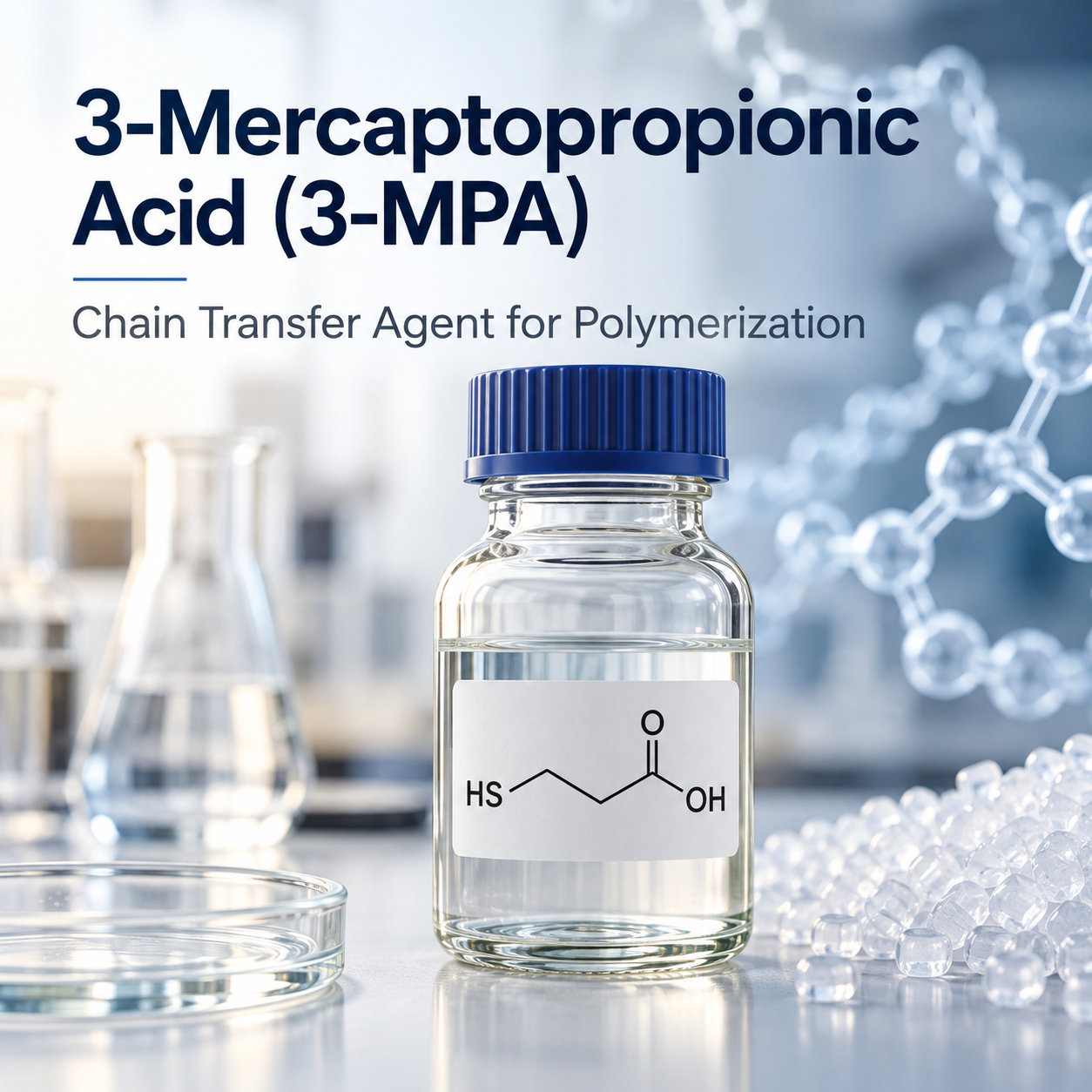
3-Mercaptopropionic Acid, commonly abbreviated as 3-MPA, is an organosulfur compound containing both a thiol (-SH) group and a carboxylic acid (-COOH) group.
Its molecular formula is:
C₃H₆O₂S
It is also known as:
3-Mercaptopropionic Acid
β-Mercaptopropionic Acid
3-MPA
The presence of two different functional groups within the same molecule gives 3-MPA useful chemical reactivity and makes it relevant to a range of industrial chemical processes.
Rather than viewing 3-MPA simply as an individual chemical product, it is more useful to understand what its thiol and carboxyl groups allow it to do in different reaction systems.
1. Why Is 3-MPA Used in Chemical Manufacturing?
The applications of 3-MPA are closely related to its molecular structure.
The molecule contains:
Thiol group (-SH)
The thiol group provides characteristic sulfur-containing reactivity and can participate in a range of chemical reactions.
Carboxyl group (-COOH)
The carboxylic acid group provides another reactive site and affects properties such as acidity and interaction with other chemical components.
Having both functional groups in one relatively small molecule allows 3-MPA to participate in reactions where controlled sulfur functionality or additional carboxyl functionality is required.
For this reason, it can be considered for applications involving:
polymer chemistry;
molecular-weight control;
polymer modification;
coatings and resins;
organic synthesis;
preparation of functional chemical intermediates.
The suitability of 3-MPA depends on the specific reaction and formulation.
2. 3-MPA as a Chain Transfer Agent
One of the important application areas associated with 3-Mercaptopropionic Acid is polymerization.
In certain free-radical polymerization systems, thiol-containing compounds can participate in chain transfer reactions.
During polymerization, growing polymer radicals continuously add monomer molecules.
When a chain transfer agent participates in the reaction, the active radical site can be transferred, affecting the continued growth of the original polymer chain.
This means that 3-MPA may be used as one of the tools for controlling polymer molecular characteristics.
3. How Does 3-MPA Affect Polymer Molecular Weight?
In a simplified polymerization system:
Monomer → initiation → polymer chain growth
Without sufficient chain transfer, polymer chains may continue growing until termination occurs.
When an appropriate chain transfer agent is introduced, additional transfer reactions can occur during polymerization.
This can influence:
average molecular weight;
molecular-weight distribution;
polymer chain length;
terminal functionality;
solution viscosity;
processing characteristics.
However, these effects depend strongly on the actual polymerization system.
Factors such as:
monomer type;
initiator;
temperature;
concentration;
reaction time;
addition method;
chain transfer agent dosage
can all influence the final polymer.
Therefore, there is no universal 3-MPA dosage that can be applied to every polymerization process.
4. Why Are Thiol Compounds Used as Chain Transfer Agents?
Thiol-containing compounds are known for their ability to participate in radical chain-transfer reactions.
The sulfur-hydrogen bond of the thiol group plays an important role in this chemistry.
Different thiol compounds have different molecular structures, however, so they should not automatically be considered interchangeable.
When selecting a chain transfer agent, chemists may need to consider:
chain transfer efficiency;
functional groups introduced into the polymer;
reaction conditions;
final polymer properties;
residual material requirements;
downstream processing.
The presence of a carboxylic acid group distinguishes 3-MPA from many other sulfur-containing chain transfer agents.
5. 3-MPA in Acrylic Polymerization
Acrylic polymers are used in a broad range of industrial formulations.
Depending on the polymer design, molecular weight can influence:
viscosity;
flow behavior;
film formation;
processing;
application characteristics.
In certain acrylic polymerization systems, 3-MPA may be evaluated as a chain transfer agent for molecular-weight control.
The required amount should be determined according to the specific monomer composition and target polymer properties.
For example, changing the ratio of:
acrylic monomers + initiator + chain transfer agent
can result in different polymer characteristics.
This is why polymerization trials are necessary when introducing 3-MPA into a new formulation.
6. Can 3-MPA Be Used in Water-Based Polymer Systems?
3-MPA can be considered in certain aqueous polymerization processes, but suitability depends on the chemistry of the system.
Important factors include:
pH;
monomer composition;
initiator system;
reaction temperature;
addition sequence;
solids content;
target molecular weight.
Because 3-MPA contains a carboxylic acid group, changes in pH can also affect its state in aqueous environments.
The actual process should therefore be evaluated experimentally rather than assuming identical behavior across all water-based polymer systems.
7. 3-MPA in Polymer Modification
3-MPA can also be considered as a functional raw material in polymer modification.
Because the molecule contains both:
-SH and -COOH
it can potentially participate in reactions where sulfur-containing functionality and carboxyl functionality are useful.
Depending on the reaction route, this may allow chemical formulators to introduce or adjust particular functional groups within a polymer or intermediate.
However, the phrase "polymer modification" covers many different chemical processes.
The suitability of 3-MPA needs to be evaluated according to:
polymer chemistry;
reaction mechanism;
required functionality;
process temperature;
catalyst or initiator;
final application.
8. What Is the Role of 3-MPA in Coating Chemistry?
Coatings are complex formulations that may contain:
resins;
pigments;
fillers;
solvents or water;
crosslinking components;
additives.
3-MPA is not simply a general-purpose "coating additive."
Its relevance to coatings is primarily connected with polymer and resin chemistry.
For example, it may be involved in the preparation or modification of polymeric materials that are subsequently used in coating formulations.
This distinction is important.
It is more technically accurate to describe 3-MPA as a functional raw material or chemical intermediate for certain coating-related polymer systems, rather than claiming that it can simply be added to any coating to improve performance.
9. 3-MPA in Resin Synthesis
Resin properties depend strongly on molecular structure.
Parameters such as:
molecular weight;
functional groups;
branching;
crosslinking potential;
polymer composition
can influence the final behavior of a resin.
Because 3-MPA can participate in several types of chemical reactions, it may be considered during the synthesis or modification of certain resin systems.
The exact role depends on the resin chemistry.
For this reason, application evaluation should begin with the reaction mechanism, rather than selecting 3-MPA only because it is described as a "resin raw material."
10. 3-MPA as a Chemical Intermediate
Another application direction for 3-Mercaptopropionic Acid is as a chemical intermediate.
An intermediate is a substance used as part of a chemical synthesis route to prepare another compound.
The thiol and carboxyl groups of 3-MPA provide two chemically useful functionalities.
This allows it to serve as a starting material or intermediate in the preparation of certain:
sulfur-containing compounds;
functional organic compounds;
polymer-related intermediates;
specialty chemical derivatives.
The exact downstream products depend on the synthesis route.
11. 3-MPA and Thiol Chemistry
The thiol group is one of the defining structural features of 3-MPA.
Thiol chemistry can include reactions such as:
radical reactions;
addition reactions;
oxidation;
reactions involving functionalization.
The behavior of the thiol group depends strongly on reaction conditions.
For example:
oxygen exposure;
temperature;
pH;
catalysts;
other reactants
can influence the reaction pathway.
This is one reason why storage and handling conditions matter when using thiol-containing chemicals.
12. Is 3-MPA the Same as Thioglycolic Acid?
No.
3-Mercaptopropionic Acid (3-MPA) and Thioglycolic Acid (TGA) are both thiol-containing carboxylic acids, but they have different molecular structures.
3-MPA can be represented structurally as:
HS-CH₂-CH₂-COOH
Thioglycolic acid can be represented as:
HS-CH₂-COOH
The difference in carbon-chain structure means that their physical properties and chemical behavior are not necessarily identical.
Therefore, one should not assume that 3-MPA and thioglycolic acid can always be substituted for each other at the same dosage.
Any substitution should be evaluated in the actual reaction system.
13. 3-MPA vs Thioglycolic Acid in Polymerization
Both compounds contain thiol functionality and may be relevant to chain-transfer chemistry.
However, selection should consider more than the presence of an -SH group.
Factors can include:
required chain transfer behavior;
polymer structure;
functional end groups;
reaction temperature;
pH;
solubility;
odor-management requirements;
downstream process.
A controlled polymerization comparison is more informative than assuming equivalent performance based only on chemical category.
14. Is 3-MPA the Same as 2-Mercaptoethanol?
No.
2-Mercaptoethanol (2-ME) contains a thiol group and a hydroxyl group.
3-MPA contains a thiol group and a carboxylic acid group.
Therefore:
2-Mercaptoethanol:
HS-CH₂-CH₂-OH
3-Mercaptopropionic Acid:
HS-CH₂-CH₂-COOH
Their different functional groups lead to different chemical properties and application considerations.
They should not be treated as direct equivalents without testing.
15. How Much 3-MPA Should Be Used in Polymerization?
There is no single dosage suitable for every polymerization process.
The required amount depends on factors including:
target molecular weight;
monomer composition;
initiator concentration;
reaction temperature;
polymerization method;
solids content;
addition method.
Increasing the amount of a chain transfer agent can significantly alter polymer molecular characteristics.
Therefore, dosage should be established through controlled experiments.
A typical development process may compare:
Formulation A: lower 3-MPA level
Formulation B: intermediate 3-MPA level
Formulation C: higher 3-MPA level
while keeping other major reaction parameters constant.
16. Why Is Addition Method Important?
The total amount of 3-MPA is not the only variable that can influence a polymerization process.
The way it is introduced may also matter.
Depending on the process, formulators may evaluate:
initial addition;
staged addition;
continuous feed;
simultaneous feed with other components.
Changing the addition profile can change the concentration of chain transfer agent present during different stages of polymerization.
This may influence the resulting molecular-weight profile.
The appropriate method should be established for the individual process.
17. Does Temperature Affect 3-MPA Application?
Yes.
Temperature can influence:
reaction rate;
initiator decomposition;
radical concentration;
chain transfer behavior;
side reactions;
oxidation processes.
For polymerization applications, temperature should therefore be treated as an important process variable.
A dosage optimized at one reaction temperature should not automatically be assumed to produce the same result at a substantially different temperature.
18. Why Is Purity Important for 3-MPA?
For a chemical raw material used in synthesis, composition consistency can be important because impurities may affect the downstream reaction.
Depending on the application, users may review parameters such as:
assay;
appearance;
water content;
relevant impurities;
other specification items.
However, a higher numerical purity value alone does not prove suitability for a particular process.
The product still needs to meet the requirements of the intended synthesis.
19. What Should Be Checked When Selecting 3-MPA?
When evaluating 3-Mercaptopropionic Acid for industrial use, it can be useful to review several areas.
Product identity
Confirm that the material is 3-Mercaptopropionic Acid and verify the relevant product documentation.
Specification
Review the parameters relevant to the intended process.
Application
Determine whether it will be used for polymerization, resin synthesis, polymer modification or another chemical reaction.
Process compatibility
Evaluate its behavior with the actual monomers, initiators, solvents and other components.
Storage and handling
Review the SDS and establish suitable procedures before use.
20. How Should 3-MPA Be Stored?
Storage conditions should follow the current Safety Data Sheet (SDS) and applicable regulations.
As a general chemical-management principle, users should consider:
suitable containers;
appropriate storage temperature;
ventilation;
prevention of incompatible chemical contact;
container closure;
occupational exposure controls.
Because 3-MPA is a reactive sulfur-containing chemical, handling requirements should be determined from the product-specific SDS rather than from a general application article alone.
21. Why Does 3-MPA Have a Characteristic Odor?
Many low-molecular-weight thiol compounds have noticeable odors associated with sulfur-containing functionality.
3-MPA also has handling characteristics associated with its chemical structure.
Industrial facilities using the material should therefore consider appropriate engineering controls and handling procedures.
Odor should not be used as a substitute for analytical quality testing.
Product conformity should be assessed against the relevant technical specification.
22. Can 3-MPA Be Used Directly in Any Polymer?
No.
The fact that 3-MPA can function as a chain transfer agent in certain polymerization systems does not mean it is suitable for every polymer.
Its suitability depends on the reaction mechanism.
For example, a formulation should consider whether:
radical polymerization is involved;
the thiol group can participate under the process conditions;
the carboxyl functionality is acceptable;
downstream polymer properties meet requirements.
Application testing is therefore necessary.
23. How to Evaluate 3-MPA in a Polymerization Process
A controlled evaluation can follow several steps.
Step 1 — Define the Target
Determine whether the goal is to modify:
molecular weight;
viscosity;
terminal functionality;
processing behavior;
another polymer characteristic.
Step 2 — Establish a Control
Run the base polymerization under established conditions.
Step 3 — Introduce 3-MPA
Evaluate selected dosage levels.
Step 4 — Keep Other Variables Stable
Where possible, maintain the same:
monomers;
initiator;
temperature;
solids content;
reaction time.
Step 5 — Analyze the Polymer
Depending on the project, relevant measurements may include:
molecular weight;
molecular-weight distribution;
viscosity;
solids content;
residual monomer;
functional-group characteristics.
Step 6 — Evaluate the Final Application
A polymer that meets a molecular-weight target still needs to perform appropriately in its intended end use.
Frequently Asked Questions About 3-Mercaptopropionic Acid
What is 3-Mercaptopropionic Acid?
3-Mercaptopropionic Acid, or 3-MPA, is an organosulfur compound containing both thiol and carboxylic acid functional groups.
What is the molecular formula of 3-MPA?
The molecular formula is C₃H₆O₂S.
What is 3-MPA used for?
Depending on the chemical process, 3-MPA can be used in polymerization, polymer modification, resin-related chemistry and organic synthesis.
Is 3-MPA a chain transfer agent?
3-MPA can function as a chain transfer agent in certain radical polymerization systems.
Why is 3-MPA used in acrylic polymerization?
It may be evaluated to control polymer molecular characteristics such as molecular weight, depending on the acrylic polymerization system.
Is 3-MPA the same as thioglycolic acid?
No. They are different chemical compounds with different molecular structures.
Is 3-MPA the same as 2-mercaptoethanol?
No. 3-MPA contains a carboxylic acid group, while 2-mercaptoethanol contains a hydroxyl group.
How much 3-MPA should be added?
There is no universal dosage. The appropriate amount depends on monomers, initiator, temperature, target molecular weight and other process conditions.
Can 3-MPA be used in coatings?
Its relevance to coatings is mainly associated with the synthesis or modification of certain polymers and resins used in coating systems. Suitability depends on the specific formulation.
How should 3-MPA be handled?
Handling and storage should follow the current SDS, applicable regulations and site-specific chemical safety procedures.
Conclusion
3-Mercaptopropionic Acid (3-MPA) is a bifunctional organosulfur compound containing both a thiol (-SH) group and a carboxylic acid (-COOH) group.
These functional groups make it relevant to several areas of industrial chemistry, particularly:
polymerization → molecular-weight control → polymer modification → resin chemistry → chemical synthesis.
In certain radical polymerization systems, 3-MPA can be evaluated as a chain transfer agent. However, its performance depends on the complete reaction system, including:
monomer composition + initiator + 3-MPA dosage + temperature + addition method + reaction time.
For this reason, selecting 3-MPA should not be based only on a product name or one specification value.
A more practical approach is:
Define the required chemical function → review the 3-MPA specification → conduct controlled reaction trials → analyze the resulting polymer → verify performance in the final application.
This provides a more meaningful basis for evaluating 3-Mercaptopropionic Acid in polymer and chemical manufacturing applications.
 How to Review a 3-MPA COA: Ass
 3-MPA vs Other Mercapto Chain
 How to Select a Reliable 3-Mer
 How Does 3-MPA Control Molecul