
3-Mercaptopropionic Acid (3-MPA) as a Chain Transfer Agent: How It Controls Polymer Molecular Weight
What Is 3-Mercaptopropionic Acid?
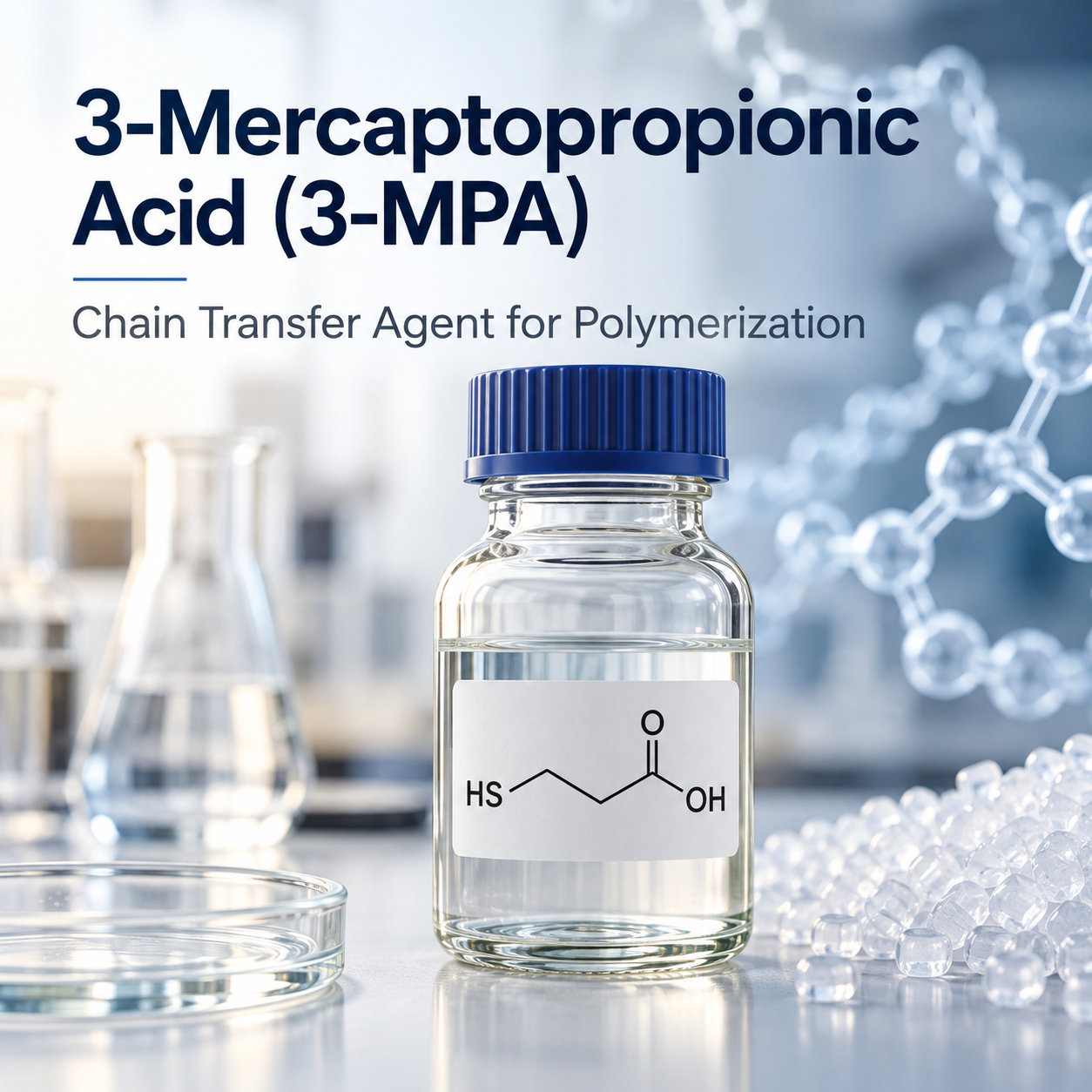
3-Mercaptopropionic acid, commonly abbreviated as 3-MPA or MPA, is an organosulfur compound containing both a thiol group (–SH) and a carboxylic acid group (–COOH).
Its basic chemical information is:
| Property | Information |
|---|---|
| Chemical name | 3-Mercaptopropionic Acid |
| Common abbreviation | 3-MPA / MPA |
| CAS number | 107-96-0 |
| Molecular formula | C₃H₆O₂S |
| Molecular weight | 106.14 g/mol |
| Structural formula | HS–CH₂–CH₂–COOH |
| Main functional groups | Thiol and carboxyl |
The combination of these two functional groups is important to the chemistry of 3-MPA.
The thiol group allows 3-MPA to participate in chain-transfer reactions under suitable free-radical polymerization conditions.
At the same time, the carboxyl group can remain associated with the resulting chain-end structure, making 3-MPA relevant to certain polymer systems where both molecular-weight regulation and carboxyl functionality are of interest.
1. What Is a Chain Transfer Agent?
To understand why 3-MPA is used in polymerization, it is useful to first understand the function of a chain transfer agent (CTA).
In conventional free-radical polymerization, the process can be simplified into several stages:
Initiation → Propagation → Chain Transfer and/or Termination
During propagation, a growing polymer radical continuously reacts with monomer molecules.
As additional monomers are incorporated, the polymer chain becomes longer.
A chain transfer agent introduces another possible reaction pathway.
Instead of continuing to add monomer, a growing polymer radical can react with the chain transfer agent. This terminates the growth of that particular polymer chain while potentially generating another radical capable of initiating or continuing polymerization.
As a result, chain transfer changes the average length of polymer chains formed during the reaction.
This is why chain transfer agents are commonly associated with polymer molecular-weight control.
2. Why Can 3-MPA Act as a Chain Transfer Agent?
The chain-transfer behavior of 3-MPA is mainly associated with its thiol group (–SH).
Thiols are well known for their ability to participate in radical transfer reactions.
In a simplified representation, a growing polymer radical may react with a thiol-containing compound:
Polymer–C• + HS–R → Polymer–CH + •S–R
Here, the original growing polymer chain obtains a hydrogen atom and stops propagating.
A sulfur-centered radical is generated and may subsequently participate in another reaction with monomer.
The actual mechanism in a polymerization system can involve additional reaction steps, but this simplified equation illustrates the basic reason why thiol compounds can regulate polymer chain length.
For 3-MPA:
R = –CH₂–CH₂–COOH
Therefore, 3-MPA combines a chain-transfer-active thiol group with a carboxyl-containing structure.
3. How Does 3-MPA Control Polymer Molecular Weight?
Polymer molecular weight depends on the balance between chain initiation, propagation, transfer and termination.
Without sufficient chain transfer, growing polymer radicals may continue incorporating monomers for longer periods, producing longer polymer chains.
When an appropriate chain transfer agent is introduced, some growing chains undergo chain transfer before they would otherwise terminate.
This reduces their average degree of polymerization.
Under otherwise comparable reaction conditions, increasing chain-transfer activity will generally tend to reduce average polymer chain length.
However, the relationship between 3-MPA dosage and molecular weight is not universal.
It depends on the complete polymerization system.
4. Does More 3-MPA Always Mean Lower Molecular Weight?
Within a given polymerization system, increasing the concentration of an effective chain transfer agent will generally increase the probability of chain-transfer events and can reduce average molecular weight.
But this should not be interpreted as:
“The more 3-MPA, the better.”
The target is normally not the lowest possible molecular weight.
Instead, the objective is to obtain a molecular-weight range appropriate for the intended polymer.
Excessive chain transfer can produce polymers with molecular characteristics outside the required range.
It may also influence properties related to molecular weight, such as:
viscosity;
rheological behavior;
solution properties;
mechanical behavior;
film formation;
processing characteristics.
The relevant properties depend on the polymer and its intended application.
For this reason, 3-MPA concentration should be selected according to the required polymer characteristics.
5. What Determines the Chain-Transfer Efficiency of 3-MPA?
3-MPA dosage is only one factor.
Its effect in a polymerization reaction can also depend on:
monomer chemistry;
monomer concentration;
initiator type;
initiator concentration;
reaction temperature;
solvent or reaction medium;
pH;
feeding strategy;
reaction time;
solids content;
polymerization conversion.
Another important concept is the chain transfer constant.
The tendency of a chain transfer agent to react with a growing polymer radical relative to monomer propagation varies according to the specific monomer and reaction conditions.
Therefore, a dosage that produces a particular molecular weight in one polymerization system cannot automatically be transferred to another system.
6. What Is the Relationship Between Chain Transfer and Molecular Weight?
A commonly used framework for understanding chain-transfer effects in free-radical polymerization is the Mayo equation.
In simplified form:
1/DPₙ = 1/DPₙ,₀ + Cₛ[S]/[M]
where:
DPₙ = number-average degree of polymerization in the presence of chain transfer;
DPₙ,₀ = degree of polymerization without that chain-transfer contribution;
Cₛ = chain transfer constant;
[S] = concentration of chain transfer agent;
[M] = monomer concentration.
This relationship helps explain why increasing the relative concentration of a chain transfer agent can decrease the average degree of polymerization.
However, actual industrial polymerization systems may be more complex than the simplified model.
For formulation work, experimental molecular-weight data remain important.
7. Why Is Molecular-Weight Control Important?
Polymer molecular weight can influence many material properties.
Depending on the polymer system, these can include:
solution viscosity;
melt viscosity;
rheology;
solubility;
mechanical properties;
processing behavior;
film properties;
functionality per unit mass.
For example, a polymer with an excessively high molecular weight may have a viscosity that is unsuitable for a particular formulation.
A polymer with an excessively low molecular weight may also fail to provide the required properties.
Therefore, molecular-weight control is usually about obtaining a defined working range, not simply minimizing molecular weight.
8. Why Is 3-MPA Used in Acrylic Polymerization?
Acrylic monomers are widely used to prepare polymers through free-radical polymerization.
Depending on the formulation, relevant monomers may include:
acrylic acid;
methacrylic acid;
acrylate esters;
methacrylate esters;
other copolymerizable vinyl monomers.
In some acrylic polymerization systems, molecular weight needs to be controlled to obtain the desired viscosity, processing behavior or functional characteristics.
A thiol-containing chain transfer agent such as 3-MPA can be evaluated for this purpose.
The actual suitability depends on the monomer composition and polymerization process.
9. What Does 3-MPA Do in Acrylic Acid Polymerization?
Acrylic acid can undergo free-radical polymerization to form polyacrylic-acid-based materials and related copolymers.
In some of these systems, 3-MPA may be used as a chain transfer agent to influence polymer chain length.
The thiol group participates in the chain-transfer process, while the carboxyl-containing portion of the molecule may contribute to the resulting chain-end functionality.
When developing such a formulation, relevant variables include:
acrylic acid concentration;
comonomers;
initiator system;
3-MPA concentration;
reaction temperature;
neutralization conditions;
feeding profile.
The required amount should therefore be established through polymerization trials rather than assumed from a fixed general dosage.
10. Can 3-MPA Be Used in Polycarboxylate Polymer Synthesis?
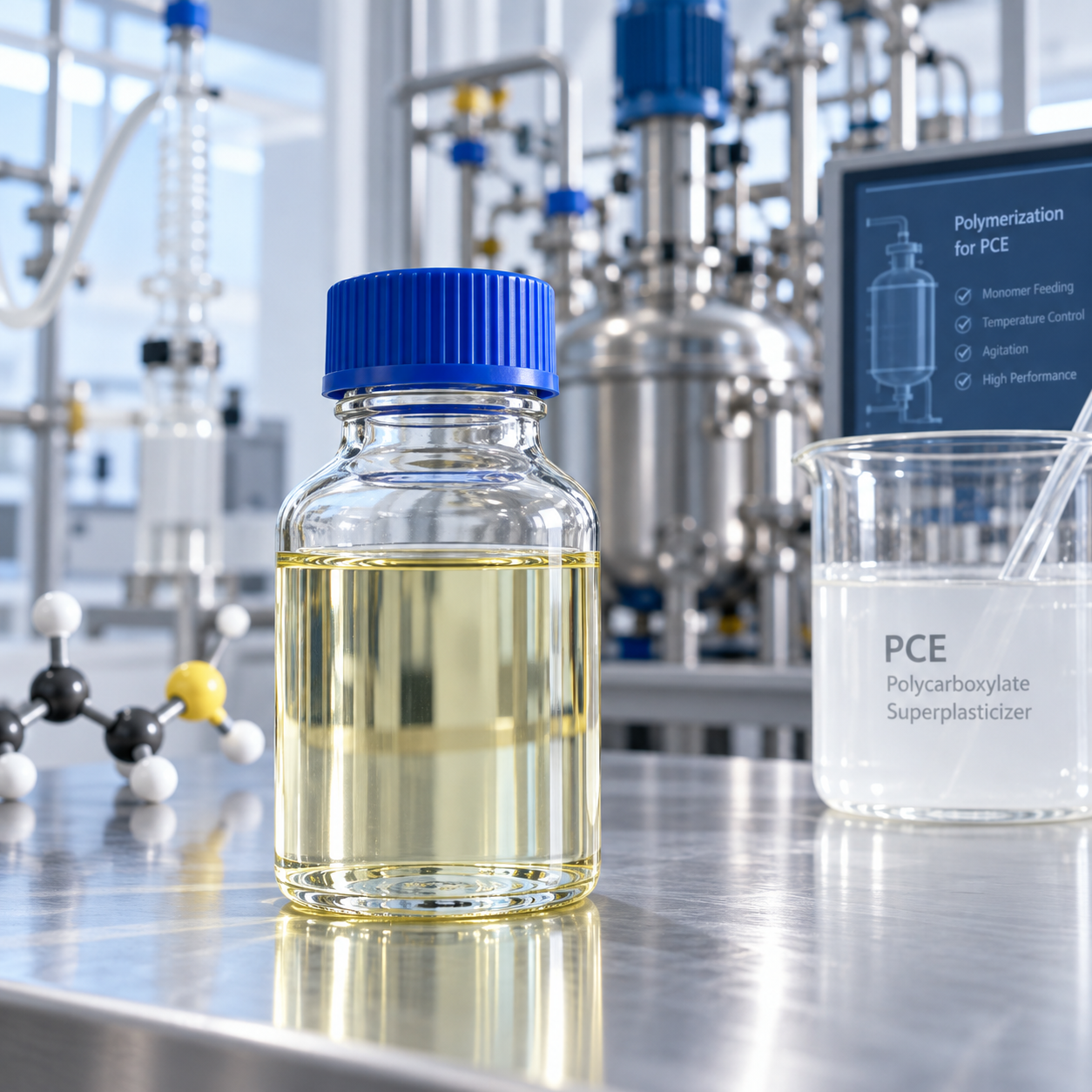
Polycarboxylate-based polymers, including materials used in certain concrete-admixture systems, are synthesized through controlled polymerization of suitable unsaturated monomers.
Molecular weight and molecular architecture can influence the properties of the resulting polymer.
Chain transfer agents may therefore be used in some synthesis routes to regulate molecular weight.
Thiol-containing compounds are among the types of chain transfer agents that can be considered.
3-MPA may be used in certain polymerization formulations, depending on:
monomer system;
polymer architecture;
initiator;
reaction temperature;
target molecular weight;
required end-group functionality.
It should not, however, be assumed that every polycarboxylate polymer synthesis requires 3-MPA.
The appropriate chain transfer agent depends on the specific polymerization route.
11. What Is a Carboxyl-Terminated Polymer?
A carboxyl-terminated polymer contains carboxyl functionality associated with one or more polymer chain ends.
Such terminal functional groups can be relevant when the polymer is intended for:
subsequent chemical modification;
coupling reactions;
surface attachment;
crosslinking;
functional material preparation.
Because 3-MPA contains a carboxyl group in addition to its thiol group, chain transfer involving 3-MPA can provide a route to introduce carboxyl-containing chain-end structures in suitable polymerization systems.
The actual end-group structure and incorporation efficiency should be confirmed analytically for the specific reaction.
12. Why Does the Carboxyl Group of 3-MPA Matter?
If the purpose were only radical chain transfer, various thiol compounds could potentially be considered.
3-MPA is distinctive because it contains:
–SH + –COOH
in the same molecule.
The thiol group provides the chain-transfer functionality.
The carboxyl group provides an additional chemical handle.
This can be useful when the polymer design requires both molecular-weight control and carboxyl functionality.
Depending on the polymer, the carboxyl group may subsequently participate in:
acid-base reactions;
esterification;
amidation;
coupling chemistry;
surface interactions.
The relevant chemistry depends on the final material and reaction conditions.
13. 3-MPA vs Thioglycolic Acid: What Is the Difference?
Thioglycolic acid (TGA) and 3-mercaptopropionic acid are both mercapto carboxylic acids.
However, they have different molecular structures.
Thioglycolic Acid
HS–CH₂–COOH
3-Mercaptopropionic Acid
HS–CH₂–CH₂–COOH
3-MPA contains one additional methylene group between the thiol and carboxyl groups.
This structural difference can influence:
physical properties;
reaction behavior;
chain-transfer characteristics;
compatibility with a particular polymerization system.
Therefore, TGA and 3-MPA should not be assumed to be interchangeable on a one-to-one weight basis.
If one chain transfer agent is replaced by another, the polymerization process should be re-evaluated experimentally.
14. 3-MPA vs 2-Mercaptoethanol
2-Mercaptoethanol is another thiol-containing compound that may be encountered in chemical synthesis.
The main functional-group difference is:
3-MPA: thiol + carboxyl group
2-Mercaptoethanol: thiol + hydroxyl group
This distinction becomes relevant when chain-end functionality matters.
A polymer formed through chain transfer involving 3-MPA can contain carboxyl-related terminal functionality, whereas a chain-transfer route involving 2-mercaptoethanol can introduce hydroxyl-related functionality.
The choice therefore depends not only on chain-transfer activity but also on the desired polymer structure.
15. How Should a Chain Transfer Agent Be Selected?
Selecting a chain transfer agent requires more than comparing product names.
Factors to consider include:
Target molecular weight
What molecular-weight range is required?
Target end group
Is a carboxyl, hydroxyl or another functional group desirable?
Monomer system
Different monomers can show different chain-transfer behavior.
Reaction medium
Water, organic solvents and other media may influence compatibility and reaction behavior.
Reaction temperature
Temperature affects polymerization kinetics and may also influence chain-transfer behavior.
Feeding process
Batch, semi-batch and continuous feeding strategies can produce different concentration profiles.
Final polymer requirements
Molecular weight, viscosity, functionality and downstream processing requirements should all be considered.
16. How Is 3-MPA Dosage Determined?
There is no universal 3-MPA dosage applicable to every polymerization process.
A practical approach is to establish a controlled series of experiments.
For example:
| Trial | 3-MPA Level | Other Conditions |
|---|---|---|
| A | Reference level | Constant |
| B | Adjusted level | Constant |
| C | Second adjusted level | Constant |
| D | Third adjusted level | Constant |
The resulting polymers can then be evaluated for:
number-average molecular weight (Mn);
weight-average molecular weight (Mw);
molecular-weight distribution;
viscosity;
conversion;
residual monomer;
functional properties relevant to the application.
This creates an experimental relationship between 3-MPA concentration and polymer characteristics.
17. Why Should Only One Major Variable Be Changed at a Time?
Suppose a polymerization trial simultaneously changes:
3-MPA concentration;
initiator concentration;
reaction temperature;
monomer feed rate.
If the molecular weight changes, it becomes difficult to identify the main cause.
For initial formulation work, it is usually more informative to hold the other major conditions constant while changing the chain transfer agent concentration.
Once the effect of 3-MPA is understood, other variables can be optimized separately.
18. How Is Polymer Molecular Weight Measured?
One commonly used analytical technique is gel permeation chromatography (GPC), also called size-exclusion chromatography (SEC).
Depending on the method, it can provide information such as:
number-average molecular weight (Mn);
weight-average molecular weight (Mw);
molecular-weight distribution.
A commonly reported parameter is dispersity:
Đ = Mw / Mn
Viscosity measurements may also provide useful process information, but viscosity alone does not provide the same molecular-weight information as an appropriate chromatographic method.
The analytical method should be selected according to the polymer and solvent system.
19. Can Polymer Viscosity Be Used to Judge 3-MPA Performance?
Viscosity can be a useful production-control parameter, particularly when the same polymer is produced repeatedly under similar conditions.
However, viscosity is influenced by more than molecular weight.
Other factors include:
polymer concentration;
temperature;
pH;
degree of neutralization;
molecular architecture;
solvent;
ionic strength.
Therefore, if molecular-weight control is the primary objective, viscosity should preferably be interpreted together with appropriate molecular-weight measurements.
20. Can 3-MPA Be Used as a Chemical Intermediate?
Yes. Its usefulness is not limited to polymer chain transfer.
Because 3-MPA contains both thiol and carboxylic acid functionality, it can participate in different organic reactions.
The carboxyl group can be involved in reactions such as:
esterification;
salt formation;
amidation.
The thiol group can participate in a range of sulfur-related reactions and thiol-based addition chemistry under appropriate conditions.
This makes 3-MPA a possible intermediate in certain organic synthesis and functional-material routes.
The suitability of a particular reaction should be evaluated according to the target chemistry.
21. Why Does 3-MPA Have a Strong Odor?
Low-molecular-weight thiol-containing compounds commonly have characteristic odors.
3-MPA also has a noticeable odor associated with its sulfur-containing functional group.
For this reason, industrial handling should consider:
closed transfer where appropriate;
workplace ventilation;
spill control;
suitable personal protective equipment.
Handling requirements should follow the applicable Safety Data Sheet (SDS) and local occupational-safety regulations.
22. What Should Be Considered When Storing 3-MPA?
Storage and handling should follow the product SDS and applicable regulations.
General considerations include:
keeping containers properly closed;
using compatible packaging and equipment;
controlling exposure to unsuitable conditions;
avoiding incompatible materials;
maintaining appropriate workplace ventilation;
following spill-response procedures.
Because thiol-containing compounds may undergo chemical changes such as oxidation under certain conditions, storage conditions should follow the technical documentation for the specific product.
23. What Specifications Should Be Checked for 3-MPA?
The relevant specifications depend on the intended application.
Common parameters may include:
assay/purity;
water content;
appearance;
color;
density;
specific impurities.
For polymerization applications, consistency can be particularly important because changes in raw-material composition may influence a controlled polymerization process.
However, product specifications alone do not fully predict polymerization behavior.
Application trials remain important when introducing a new grade, batch or source into an established process.
24. Does Higher 3-MPA Purity Always Produce a Better Polymer?
Not necessarily.
Purity is an important raw-material parameter, but polymerization results also depend on:
water content;
impurity profile;
actual 3-MPA concentration;
initiator system;
monomer quality;
temperature;
feeding profile;
pH;
process control.
The appropriate raw-material specification should therefore be determined according to the requirements of the polymerization process.
A higher numerical purity value alone does not establish the final performance of a polymer.
25. Why Should a New Batch of 3-MPA Be Tested?
In polymerization processes where molecular weight is closely controlled, changes in raw materials can influence process consistency.
Before introducing a new batch or source into full-scale production, it may be useful to compare:
assay;
water;
relevant impurities;
color and appearance;
polymerization behavior;
resulting molecular weight;
viscosity;
conversion.
The required level of incoming-material verification depends on the sensitivity of the production process.
26. Common Polymerization Problem: Molecular Weight Is Too High
If the resulting polymer molecular weight is higher than the target range, possible factors may include:
insufficient chain-transfer activity;
3-MPA concentration;
feeding profile;
monomer concentration;
initiator conditions;
reaction temperature.
The cause should be identified through controlled experiments.
Simply adding a large excess of chain transfer agent is not an appropriate substitute for understanding the polymerization system.
27. Common Polymerization Problem: Molecular Weight Is Too Low
If molecular weight falls below the target range, possible factors include:
excessive chain transfer;
excessive 3-MPA concentration;
changes in initiator concentration;
reaction-temperature changes;
changes in monomer feed;
other chain-transfer-active substances.
The formulation should be reviewed systematically rather than adjusting several parameters simultaneously.
28. Frequently Asked Questions About 3-MPA
What is 3-MPA?
3-MPA is the commonly used abbreviation for 3-mercaptopropionic acid, CAS 107-96-0.
What is 3-mercaptopropionic acid used for?
It is used in certain polymerization systems as a chain transfer agent and can also be used as an intermediate in organic synthesis and functional-material chemistry.
Why is 3-MPA a chain transfer agent?
Its thiol group can participate in radical chain-transfer reactions, affecting the growth of polymer chains.
Does 3-MPA reduce polymer molecular weight?
In suitable free-radical polymerization systems, increased chain-transfer activity can reduce average polymer chain length and influence molecular weight. The actual result depends on the complete reaction system.
Does more 3-MPA always mean better molecular-weight control?
No. The appropriate amount depends on the target molecular weight and other polymer requirements.
Can 3-MPA be used in acrylic polymerization?
It can be evaluated as a chain transfer agent in suitable acrylic and related free-radical polymerization systems.
Is 3-MPA the same as thioglycolic acid?
No. They are different chemical compounds with different molecular structures.
Can thioglycolic acid replace 3-MPA?
Direct one-to-one substitution should not be assumed. A change in chain transfer agent should be evaluated through polymerization trials.
What is the difference between 3-MPA and 2-mercaptoethanol?
3-MPA contains a carboxyl group, while 2-mercaptoethanol contains a hydroxyl group. This difference can influence the functional group introduced at the polymer chain end.
Can 3-MPA be used for carboxyl-functional polymers?
In suitable chain-transfer polymerization systems, the structure of 3-MPA can provide carboxyl-containing chain-end functionality. The actual polymer structure should be confirmed analytically.
Conclusion
3-Mercaptopropionic acid (3-MPA, CAS 107-96-0) is a bifunctional molecule containing both a thiol group and a carboxylic acid group.
Its thiol functionality enables 3-MPA to participate in chain-transfer reactions in suitable free-radical polymerization systems. Through this mechanism, it can influence polymer chain length and molecular weight.
Its carboxyl group provides an additional structural feature that can be relevant when carboxyl-functional chain ends are required.
However, the effect of 3-MPA cannot be defined by dosage alone. Polymer molecular weight is also influenced by monomer chemistry, initiator concentration, temperature, reaction medium, feeding strategy and other process conditions.
For this reason, the use of 3-MPA as a chain transfer agent should be evaluated through controlled polymerization trials. Measurements such as Mn, Mw, molecular-weight distribution, viscosity, conversion and residual monomer can then be used to establish a relationship between 3-MPA concentration and the required polymer characteristics.
For polymer formulation work, the objective is not simply to use more chain transfer agent or obtain the lowest molecular weight, but to select reaction conditions that produce a polymer within the target molecular-weight and functional range required by the specific application.
 3-MPA vs Other Mercapto Chain
 How to Select a Reliable 3-Mer
 How Does 3-MPA Control Molecul
 3-Mercaptopropionic Acid as a